

What is DSA in Programming? Ultimate Guide for Beginners (2026)
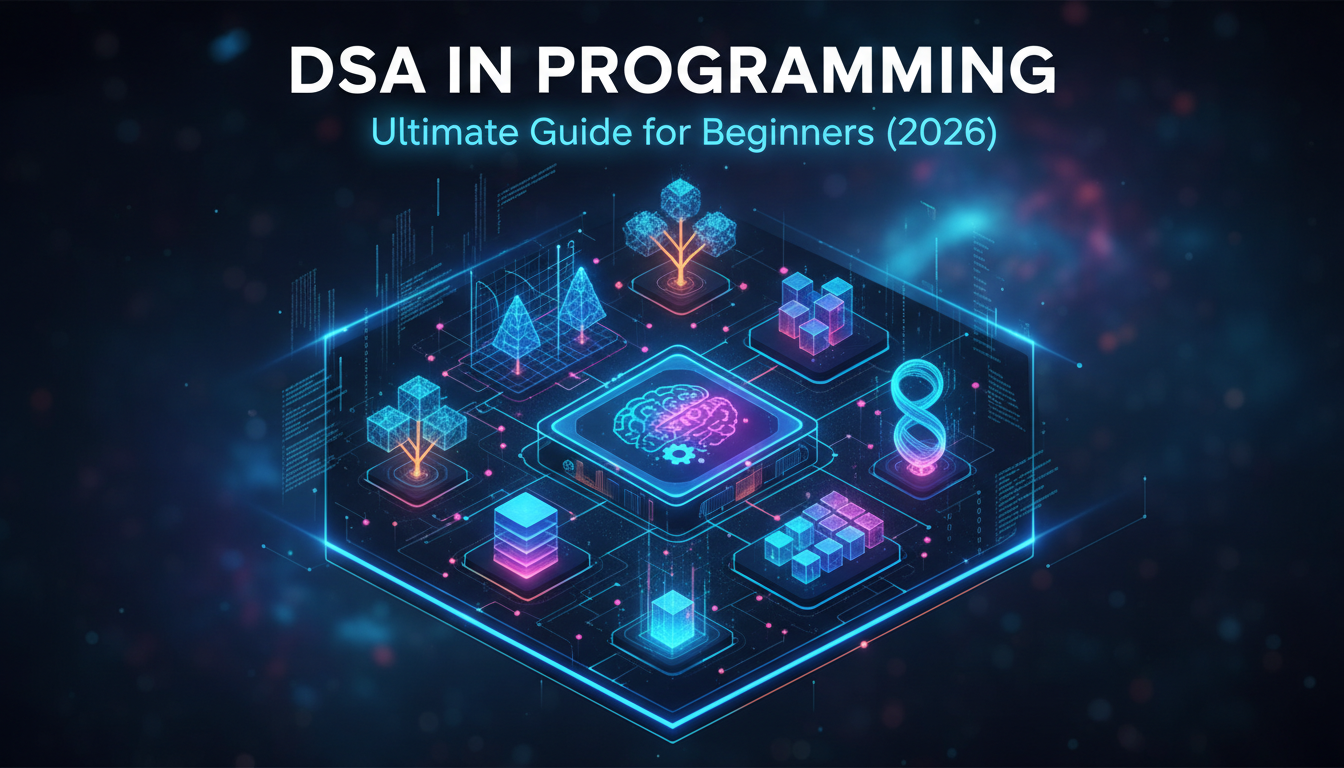
In the rapidly evolving landscape of 2026, where AI agents and automated code generation are becoming the norm, a fundamental question often surfaces for aspiring developers: What is DSA in programming, and is it still relevant?
If you are looking to break into tech or aim for a high-paying role at a product-based company, understanding Data Structures and Algorithms (DSA) is no longer just an "academic requirement"—it is the literal backbone of efficient software engineering. Whether you're optimizing a machine learning model or building a scalable web app, DSA is what separates a coder from a problem solver.
Understanding the Basics: What Exactly is DSA?
To understand "What is DSA," we need to break the acronym into its two fundamental components: Data Structures and Algorithms.
1. Data Structures: The "Storage"
A Data Structure is a specialized format for organizing, processing, retrieving, and storing data. Think of it as a physical filing cabinet or a library's shelving system. If you throw books into a pile, finding one takes forever. If you organize them by genre or author, you find them in seconds.
In programming, choosing the right data structure (like an Array, Linked List, or Hash Map) ensures that your data is stored in a way that makes it easy to use efficiently.
2. Algorithms: The "Logic"
An Algorithm is a step-by-step procedure or a set of rules used to solve a specific problem or perform a calculation. In simple terms, it is a recipe. If the data structure is the "ingredients," the algorithm is the "cooking instructions" that turn those ingredients into a finished meal.
Common algorithms include searching for a specific value in a database, sorting a list of names alphabetically, or finding the shortest path on a GPS map.
Why is DSA Important in 2026?
You might wonder why we still focus on DSA when AI can write code for us. The reality is that AI can generate syntax, but it cannot always guarantee architectural efficiency. Here is why DSA remains king:
- Optimized Resource Management: As we move toward more complex systems, memory and processing power are still finite. DSA teaches you how to write code that runs faster and uses less battery/RAM.
- The Gold Standard for Interviews: Top-tier companies like Google, Meta, and Amazon use DSA to test a candidate's logical thinking. They aren't looking for someone who knows the syntax; they want someone who can solve complex problems under constraints.
- Foundation for AI and ML: Modern AI relies on matrix transformations (Arrays) and neural networks (Graphs). Without a solid grasp of DSA, you are merely using tools you don’t understand.
Core Data Structures You Need to Know
To master DSA, you must start with the building blocks. These are the most common structures used in industry-level programming:
|
Data Structure |
Best Use Case |
Key Advantage |
|
Array |
Storing items in a fixed order. |
Fast access via index. |
|
Linked List |
Dynamic memory allocation. |
Easy insertion/deletion. |
|
Stack (LIFO) |
Undo/Redo features in apps. |
Simple "Last-In-First-Out" logic. |
|
Queue (FIFO) |
Task scheduling or printers. |
Process data in order of arrival. |
|
Hash Table |
Fast lookups (like a dictionary). |
Near-instant search. |
|
Trees |
Hierarchical data (Folders/Files). |
Efficient searching and sorting. |
|
Graphs |
Social networks or GPS maps. |
Modeling complex relationships. |
Essential Algorithms Every Programmer Should Master
Once you understand how to store data, you need to know how to manipulate it. Here are the core algorithmic paradigms:
1. Searching Algorithms
Used to find an element within a data structure.
- Linear Search: Checking one by one.
- Binary Search: A much faster method that repeatedly divides a sorted list in half.
2. Sorting Algorithms
Used to arrange data in a specific order.
- Merge Sort & Quick Sort: Highly efficient "Divide and Conquer" methods used in production environments.
3. Dynamic Programming (DP)
This is an optimization technique where you solve a complex problem by breaking it down into simpler sub-problems. It is the secret sauce behind many complex optimizations in 2026 tech stacks.
Time and Space Complexity: The Big O Notation
In the world of DSA, "working" isn't enough; it must be "efficient." We measure this using Big O Notation.
- Time Complexity: How much longer an algorithm takes as the input grows.
- Space Complexity: How much extra memory an algorithm requires.
For example, an $O(1)$ algorithm takes the same time regardless of data size, while an $O(n^2)$ algorithm might slow down significantly as data increases. Mastering this allows you to justify your technical decisions during a Gradus or a senior-level technical review.
A Step-by-Step Roadmap to Learn DSA in 2026
If you're starting from scratch, don't get overwhelmed. Follow this logical path:
- Pick a Language: Choose one language (Python for simplicity, C++ or Java for performance) and stick with it.
- Learn the Fundamentals: Master loops, recursion, and basic memory management.
- Study Linear Structures: Start with Arrays, Strings, and Linked Lists.
- Master Non-Linear Structures: Move to Trees and Graphs.
- Understand Patterns: Instead of memorizing 500 problems, learn "Patterns" like Sliding Window, Two Pointers, and DFS/BFS.
- Practice Consistently: Use platforms like LeetCode, HackerRank, or CodeChef to apply what you’ve learned.
Career Opportunities: Where Does DSA Take You?
Mastering DSA isn't just about passing an interview; it opens doors to specialized, high-paying roles:
- Software Development Engineer (SDE): Building the core logic of applications.
- Data Scientist: Handling massive datasets efficiently.
- System Architect: Designing how large-scale systems communicate.
- Game Developer: Optimizing real-time physics and rendering.
Conclusion: Is DSA Worth the Effort?
In short: Yes. While the tools we use to write code are changing, the logic that governs how computers think is not. Understanding "what is DSA in programming" gives you the blueprint for every piece of software ever created. It transforms you from a "script-kiddie" into a professional engineer capable of building the next generation of technology.
The journey to mastering DSA is a marathon, not a sprint. Start with the basics, focus on the "why" behind the logic, and you’ll find yourself solving problems you once thought were impossible.
Frequently Asked Questions (FAQs)
Can I learn DSA without knowing a programming language?
No. You need a language (like Python or Java) to implement the concepts. Learn the syntax first, then dive into DSA.
Is DSA required for Frontend Development?
While less frequent in daily CSS/HTML work, top companies still test Frontend Engineers on DSA to ensure they have strong logic and can handle complex state management.
How long does it take to get good at DSA?
For a beginner DSA Course, it typically takes 3 to 6 months of consistent practice to become comfortable with medium-level interview problems.

